
 =======
 >>>>>>> 63583bcf2d1c48866d6cb09279ca425cc19a4907



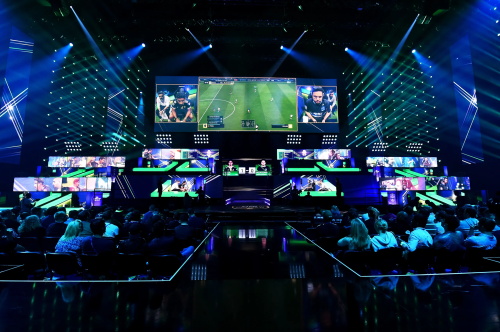
——A Boundary Exploration of What Defines “Sport”
By Alex Chen | Updated on April 2, 2026 | 🕓 12 min read
Key Highlights
- Is esports really less physically demanding than traditional sports?
- How fast are esports players compared to traditional athletes?
- Why are esports careers so short?
- Do esports players suffer from injuries?
- Should esports be considered a sport?
The debate over whether esports should be considered a sport often falls into a binary opposition: “Does it involve physical exertion or not?” However, modern sports science offers a more effective evaluation framework—one that moves beyond intuition (whether it looks like a sport) and instead relies on measurable physiological and psychological indicators.
Based on international sports science research and frameworks discussed by organizations such as the International Olympic Committee, sport is typically understood as a composite of four core elements: physical exertion, structured competition, skill development, and institutional recognition. Under this framework, esports occupies a complex middle ground:
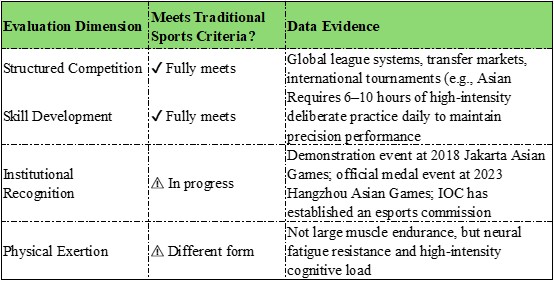
Within this framework, esports is not “lacking physicality,” but rather represents a shift in the form of physiological load.
Here, we analyze esports through three data-driven dimensions:
physical/neural intensity, career longevity, and injury models.
I. Physical vs. Non-Physical: From “Large Muscle Groups” to “Central Nervous System Load”
The core of traditional sports lies in large muscle group strength and cardiovascular endurance, while esports centers on fine motor control and extreme central nervous system load.
1. Physiological Data Comparison of Performance Load
Although esports players appear sedentary, their internal physiological stress responses resemble those seen in intense physical activity:
Heart Rate: During high-level esports competition, players’ heart rates typically range from 120–160 bpm. While lower than peak levels in basketball or football, this is comparable to the average heart rate of marathon runners and can be sustained for hours.
Energy Metabolism: Traditional sports (e.g., swimming, long-distance running) rely primarily on aerobic metabolism. Esports, due to its intense cognitive demands, places significant energy consumption on the nervous system.
Multiple studies published in sports and health journals (including those indexed by the National Institutes of Health) show that esports competition triggers sympathetic nervous system activation, significant changes in heart rate variability (HRV), and stress levels that correlate positively with competitive intensity.
This suggests that esports is not a “low-intensity activity,” but rather a physiological stress state driven by cognitive pressure.
2. Fundamental Differences in Muscle Usage
Applying sports science theory reveals:
Traditional Sports = Macro Physicality: Involves large muscle groups, strength, explosiveness, and cardiovascular endurance (e.g., lower body and core in basketball players).
Esports = Micro Precision: Involves high-frequency contractions of finger flexors, isometric contraction of forearm muscles, and complex hand-eye-brain coordination.
Esports does not require “less physical effort,” but instead shifts the workload from the cardiovascular and skeletal muscle systems to neurons and tendons. It is a “small-muscle sport” demanding neural transmission speed and extreme precision.
II. Reaction Speed: A Universal “Hard Currency” of Elite Performance
Reaction time is the most quantifiable bridge between esports and traditional sports. Data shows strong overlap in this foundational ability.
Baseline Comparison
- Average adult: 250–300 ms
- Professional esports players: 150–250 ms (e.g., players in CS:GO or Overwatch)
- Elite traditional athletes: ~200 ms (e.g., Formula 1 start reactions, baseball hitters)
Research shows that elite esports players significantly outperform lower-ranked players in simple reaction-time tasks. This ability is not just about “seeing faster,” but about the entire chain of perception → judgment → decision → execution.
Shared Mechanisms with Traditional Sports
In baseball batting, tennis returns, or racing starts, elite athletes rely on:
- Anticipation
- High-speed visual processing
- Millisecond-level decision-making
Thus, the underlying mechanisms are not oppositional, but rather share the same time-constrained cognitive decision system.
III. Career Longevity: Why Do Esports Peaks Come Earlier and End Faster?
This is the most striking and data-driven difference between esports and traditional sports. Based on longitudinal analysis of over 15,000 players, esports careers exhibit a clear pattern of accelerated aging.
1. Age Structure Trends (Based on Research Consensus)
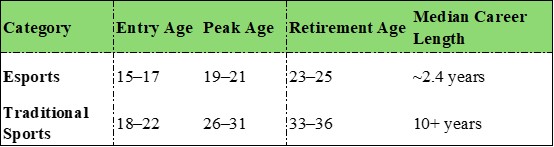
While there is no universally agreed-upon median career length for esports, there is strong consensus that:
Esports careers are significantly shorter than most traditional sports.
2. Core Mechanisms Behind Short Esports Careers
① Physiological Decline in Reaction Speed
Neuroscience research indicates that human processing speed and reaction efficiency begin to show statistically significant decline around age 24.
In traditional sports, experience can compensate for a 20–30 ms delay. In esports, however, frequent game meta changes limit the “shelf life” of experience, meaning reaction speed decline directly translates into performance deterioration.
② Early Specialization and Burnout
Esports players often specialize at a very young age. Data shows that more than half sign professional contracts before age 16.
This early, high-intensity training (often 10+ hours daily) leads to severe physical and psychological burnout, causing many players to lose motivation just as traditional athletes are entering their peak years.
③ Ruthless Iteration and Replacement
Unlike traditional sports, where selection often depends on fixed physical traits (height, wingspan), esports has a relatively low entry barrier.
This leads to rapid generational turnover: each year brings new 18-year-old prodigies, pushing 23-year-old veterans into retirement.
IV. Injury Models: From Acute Trauma to Repetitive Strain
Another strong argument that esports is a serious competitive discipline is that it has a high prevalence of injuries—just of a different kind.
1. Injury Type Comparison
- Traditional Sports Injuries: Mostly acute (e.g., ACL tears, fractures, muscle strains), typically caused by sudden physical impact.
- Esports Injuries: Mostly chronic and cumulative, caused by thousands of repetitive movements and prolonged static posture.
2. Epidemiological Data in Esports
According to a 2022 systematic review published in the Journal of Medical Internet Research (DiFrancisco-Donoghue et al.), the prevalence of musculoskeletal disorders among esports players ranges from 55% to 75%.
- High-risk areas: Neck, lower back (lumbar disc pressure), wrists (carpal tunnel syndrome, tendinitis)
- Typical cases: De Quervain’s tenosynovitis and forearm overuse injuries are direct medical causes of retirement
3. Fundamental Difference
Traditional sports injure “muscles, bones, and ligaments”; esports injures “nerves and joints.”
Esports injury patterns are closer to those of professional pianists or surgeons than football players. It is a form of functional degeneration caused by high-precision, high-frequency, long-duration repetitive actions.
Although less visually dramatic, these injuries are equally career-ending.
Conclusion: An Independent “Cognitive Competitive Form”
Returning to the original question: Is esports a sport?
If sport is strictly defined as large-muscle physical activity aimed at improving health through physical exertion, then esports does not fully meet that definition—it resembles a high-level cognitive and fine-motor competition.
However, if sport is defined as structured competition involving training, tactics, and competitive spirit within an organized system, then esports is undeniably an evolution of sport in the digital age.
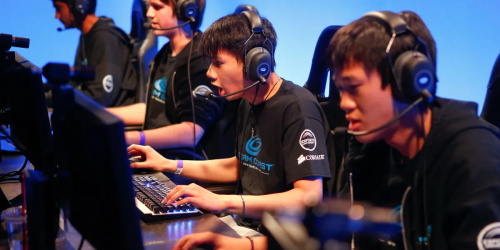
Key Takeaways
1. From a scientific perspective: Esports places demands on neural intensity, cognitive load, and reaction speed that rival or exceed many traditional sports.
2. From a career health perspective: Esports players face more severe career longevity challenges, with peak performance declining as early as age 21.
3. From a definitional perspective: Rather than forcing esports into traditional categories, it may be more accurate to define it as a
“neuro-muscular competitive system based on electronic platforms.”
A More Important Question
Rather than debating whether esports qualifies as a sport, more meaningful research questions include:
- How can esports career longevity be extended?
- How can the high prevalence of chronic injuries be reduced?
- How can scientific training and recovery systems be established?
These questions are not only critical to the development of the esports industry, but may also push the broader field of sports science toward a deeper understanding of the limits of human performance.
For a deeper breakdown of how esports players actually train compared to traditional athletes, see our full guide on training systems and reaction development: "Esports Training vs Athletic Training: Comparing Physical Demand, Reaction Time, and Training Systems "
FAQs
1. Do esports players need physical training?
Yes. While esports focuses on cognitive and fine motor performance, physical fitness (especially posture, core strength, and cardiovascular health) plays a critical role in maintaining long-term performance and preventing injury.
2. Why do esports players retire so early?
Early retirement is driven by a combination of reaction time decline, mental fatigue, repetitive strain injuries, and intense competition from younger players entering the scene.
3. Are esports injuries as serious as traditional sports injuries?
They are different but equally impactful. While traditional sports often involve acute injuries, esports injuries are typically chronic and can permanently affect performance if untreated.
4. Can experience compensate for slower reaction time in esports?
Only to a limited extent. Unlike traditional sports, where tactical knowledge can offset physical decline, frequent game updates (meta changes) reduce the long-term value of experience in esports.
5. Is esports officially recognized as a sport globally?
Recognition is still evolving. Events like the Asian Games have included esports, and organizations like the International Olympic Committee are actively exploring its role in future sporting ecosystems.
References
1. DiFrancisco-Donoghue, J., Balentine, J., Schmidt, G., & Zwibel, H. (2022). Managing the health of the eSport athlete: An integrated health management model. Journal of Medical Internet Research, 24(4), e25432.
2. Kari, T., & Karhulahti, V.-M. (2016). Do e-athletes move? A study on training and physical exercise in elite esports. International Journal of Gaming and Computer-Mediated Simulations, 8(4), 53–66.
3. Pedraza-Ramirez, I., Musculus, L., Raab, M., & Laborde, S. (2020). Setting the scientific stage for esports psychology: A systematic review. International Review of Sport and Exercise Psychology, 13(1), 319–352.
4. Bányai, F., Griffiths, M. D., Király, O., & Demetrovics, Z. (2019). The psychology of esports: A systematic literature review. Journal of Gambling Studies, 35(2), 351–365.
5. Reitman, J. G., Anderson-Coto, M. J., Wu, M., Lee, J. S., & Steinkuehler, C. (2020). Esports research: A literature review. Games and Culture, 15(1), 32–50.
About the Author
Alex Chen is a performance-focused esports and sports science writer with a background in competitive gaming and applied human performance research.
He has worked closely with semi-professional esports teams as a training consultant, focusing on reaction time optimization, fatigue management, and injury prevention strategies. His research interests include cognitive load in high-performance environments, neuro-motor efficiency, and the evolving intersection between digital competition and traditional sports science.
Editorial Transparency Statement
This article is based on a synthesis of peer-reviewed academic research, publicly available data, and industry observations. All efforts have been made to ensure accuracy, objectivity, and relevance.
The author does not have any undisclosed financial relationships with esports organizations, teams, or governing bodies that could influence the content of this analysis.
Disclaimer
This content is intended for informational and educational purposes only. It does not constitute medical, professional, or career advice.
Readers experiencing physical discomfort, repetitive strain injuries, or mental fatigue related to gaming or training should consult qualified healthcare or sports performance professionals.
=======
--A Boundary Exploration of What Defines "Sport/span>
By Alex Chen | Updated on April 2, 2026 | 🕓 12 min read
Key Highlights
- Is esports really less physically demanding than traditional sports?
- How fast are esports players compared to traditional athletes?
- Why are esports careers so short?
- Do esports players suffer from injuries?
- Should esports be considered a sport?
The debate over whether esports should be considered a sport often falls into a binary opposition: "Does it involve physical exertion or not?However, modern sports science offers a more effective evaluation framework-one that moves beyond intuition (whether it looks like a sport) and instead relies on measurable physiological and psychological indicators.
Based on international sports science research and frameworks discussed by organizations such as the International Olympic Committee, sport is typically understood as a composite of four core elements: physical exertion, structured competition, skill development, and institutional recognition. Under this framework, esports occupies a complex middle ground:

Within this framework, esports is not "lacking physicality,but rather represents a shift in the form of physiological load.
Here, we analyze esports through three data-driven dimensions:
physical/neural intensity, career longevity, and injury models.
I. Physical vs. Non-Physical: From "Large Muscle Groupsto "Central Nervous System Load/span>
The core of traditional sports lies in large muscle group strength and cardiovascular endurance, while esports centers on fine motor control and extreme central nervous system load.
1. Physiological Data Comparison of Performance Load
Although esports players appear sedentary, their internal physiological stress responses resemble those seen in intense physical activity:
Heart Rate: During high-level esports competition, playersheart rates typically range from 12060 bpm. While lower than peak levels in basketball or football, this is comparable to the average heart rate of marathon runners and can be sustained for hours.
Energy Metabolism: Traditional sports (e.g., swimming, long-distance running) rely primarily on aerobic metabolism. Esports, due to its intense cognitive demands, places significant energy consumption on the nervous system.
Multiple studies published in sports and health journals (including those indexed by the National Institutes of Health) show that esports competition triggers sympathetic nervous system activation, significant changes in heart rate variability (HRV), and stress levels that correlate positively with competitive intensity.
This suggests that esports is not a "low-intensity activity,but rather a physiological stress state driven by cognitive pressure.
2. Fundamental Differences in Muscle Usage
Applying sports science theory reveals:
Traditional Sports = Macro Physicality: Involves large muscle groups, strength, explosiveness, and cardiovascular endurance (e.g., lower body and core in basketball players).
Esports = Micro Precision: Involves high-frequency contractions of finger flexors, isometric contraction of forearm muscles, and complex hand-eye-brain coordination.
Esports does not require "less physical effort,but instead shifts the workload from the cardiovascular and skeletal muscle systems to neurons and tendons. It is a "small-muscle sport/strong> demanding neural transmission speed and extreme precision.
II. Reaction Speed: A Universal "Hard Currencyof Elite Performance
Reaction time is the most quantifiable bridge between esports and traditional sports. Data shows strong overlap in this foundational ability.
Baseline Comparison
- Average adult: 25000 ms
- Professional esports players: 15050 ms (e.g., players in CS:GO or Overwatch)
- Elite traditional athletes: ~200 ms (e.g., Formula 1 start reactions, baseball hitters)
Research shows that elite esports players significantly outperform lower-ranked players in simple reaction-time tasks. This ability is not just about "seeing faster,but about the entire chain of perception judgment decision execution.
Shared Mechanisms with Traditional Sports
In baseball batting, tennis returns, or racing starts, elite athletes rely on:
- Anticipation
- High-speed visual processing
- Millisecond-level decision-making
Thus, the underlying mechanisms are not oppositional, but rather share the same time-constrained cognitive decision system.
III. Career Longevity: Why Do Esports Peaks Come Earlier and End Faster?
This is the most striking and data-driven difference between esports and traditional sports. Based on longitudinal analysis of over 15,000 players, esports careers exhibit a clear pattern of accelerated aging.
1. Age Structure Trends (Based on Research Consensus)

While there is no universally agreed-upon median career length for esports, there is strong consensus that:
Esports careers are significantly shorter than most traditional sports.
2. Core Mechanisms Behind Short Esports Careers
Physiological Decline in Reaction Speed
Neuroscience research indicates that human processing speed and reaction efficiency begin to show statistically significant decline around age 24.
In traditional sports, experience can compensate for a 200 ms delay. In esports, however, frequent game meta changes limit the "shelf lifeof experience, meaning reaction speed decline directly translates into performance deterioration.
Early Specialization and Burnout
Esports players often specialize at a very young age. Data shows that more than half sign professional contracts before age 16.
This early, high-intensity training (often 10+ hours daily) leads to severe physical and psychological burnout, causing many players to lose motivation just as traditional athletes are entering their peak years.
Ruthless Iteration and Replacement
Unlike traditional sports, where selection often depends on fixed physical traits (height, wingspan), esports has a relatively low entry barrier.
This leads to rapid generational turnover: each year brings new 18-year-old prodigies, pushing 23-year-old veterans into retirement.
IV. Injury Models: From Acute Trauma to Repetitive Strain
Another strong argument that esports is a serious competitive discipline is that it has a high prevalence of injuries-just of a different kind.
1. Injury Type Comparison
- Traditional Sports Injuries: Mostly acute (e.g., ACL tears, fractures, muscle strains), typically caused by sudden physical impact.
- Esports Injuries: Mostly chronic and cumulative, caused by thousands of repetitive movements and prolonged static posture.
2. Epidemiological Data in Esports
According to a 2022 systematic review published in the Journal of Medical Internet Research (DiFrancisco-Donoghue et al.), the prevalence of musculoskeletal disorders among esports players ranges from 55% to 75%.
- High-risk areas: Neck, lower back (lumbar disc pressure), wrists (carpal tunnel syndrome, tendinitis)
- Typical cases: De Quervain's tenosynovitis and forearm overuse injuries are direct medical causes of retirement
3. Fundamental Difference
Traditional sports injure "muscles, bones, and ligaments esports injures "nerves and joints./span>
Esports injury patterns are closer to those of professional pianists or surgeons than football players. It is a form of functional degeneration caused by high-precision, high-frequency, long-duration repetitive actions.
Although less visually dramatic, these injuries are equally career-ending.
Conclusion: An Independent "Cognitive Competitive Form/span>
Returning to the original question: Is esports a sport?
If sport is strictly defined as large-muscle physical activity aimed at improving health through physical exertion, then esports does not fully meet that definition-it resembles a high-level cognitive and fine-motor competition.
However, if sport is defined as structured competition involving training, tactics, and competitive spirit within an organized system, then esports is undeniably an evolution of sport in the digital age.

Key Takeaways
1. From a scientific perspective: Esports places demands on neural intensity, cognitive load, and reaction speed that rival or exceed many traditional sports.
2. From a career health perspective: Esports players face more severe career longevity challenges, with peak performance declining as early as age 21.
3. From a definitional perspective: Rather than forcing esports into traditional categories, it may be more accurate to define it as a
"neuro-muscular competitive system based on electronic platforms./strong>
A More Important Question
Rather than debating whether esports qualifies as a sport, more meaningful research questions include:
- How can esports career longevity be extended?
- How can the high prevalence of chronic injuries be reduced?
- How can scientific training and recovery systems be established?
These questions are not only critical to the development of the esports industry, but may also push the broader field of sports science toward a deeper understanding of the limits of human performance.
For a deeper breakdown of how esports players actually train compared to traditional athletes, see our full guide on training systems and reaction development: "Esports Training vs Athletic Training: Comparing Physical Demand, Reaction Time, and Training Systems "
FAQs
1. Do esports players need physical training?
Yes. While esports focuses on cognitive and fine motor performance, physical fitness (especially posture, core strength, and cardiovascular health) plays a critical role in maintaining long-term performance and preventing injury.
2. Why do esports players retire so early?
Early retirement is driven by a combination of reaction time decline, mental fatigue, repetitive strain injuries, and intense competition from younger players entering the scene.
3. Are esports injuries as serious as traditional sports injuries?
They are different but equally impactful. While traditional sports often involve acute injuries, esports injuries are typically chronic and can permanently affect performance if untreated.
4. Can experience compensate for slower reaction time in esports?
Only to a limited extent. Unlike traditional sports, where tactical knowledge can offset physical decline, frequent game updates (meta changes) reduce the long-term value of experience in esports.
5. Is esports officially recognized as a sport globally?
Recognition is still evolving. Events like the Asian Games have included esports, and organizations like the International Olympic Committee are actively exploring its role in future sporting ecosystems.
References
1. DiFrancisco-Donoghue, J., Balentine, J., Schmidt, G., & Zwibel, H. (2022). Managing the health of the eSport athlete: An integrated health management model. Journal of Medical Internet Research, 24(4), e25432.
2. Kari, T., & Karhulahti, V.-M. (2016). Do e-athletes move? A study on training and physical exercise in elite esports. International Journal of Gaming and Computer-Mediated Simulations, 8(4), 536.
3. Pedraza-Ramirez, I., Musculus, L., Raab, M., & Laborde, S. (2020). Setting the scientific stage for esports psychology: A systematic review. International Review of Sport and Exercise Psychology, 13(1), 31952.
4. Bányai, F., Griffiths, M. D., Király, O., & Demetrovics, Z. (2019). The psychology of esports: A systematic literature review. Journal of Gambling Studies, 35(2), 35165.
5. Reitman, J. G., Anderson-Coto, M. J., Wu, M., Lee, J. S., & Steinkuehler, C. (2020). Esports research: A literature review. Games and Culture, 15(1), 320.
About the Author
Alex Chen is a performance-focused esports and sports science writer with a background in competitive gaming and applied human performance research.
He has worked closely with semi-professional esports teams as a training consultant, focusing on reaction time optimization, fatigue management, and injury prevention strategies. His research interests include cognitive load in high-performance environments, neuro-motor efficiency, and the evolving intersection between digital competition and traditional sports science.
Editorial Transparency Statement
This article is based on a synthesis of peer-reviewed academic research, publicly available data, and industry observations. All efforts have been made to ensure accuracy, objectivity, and relevance.
The author does not have any undisclosed financial relationships with esports organizations, teams, or governing bodies that could influence the content of this analysis.
Disclaimer
This content is intended for informational and educational purposes only. It does not constitute medical, professional, or career advice.
Readers experiencing physical discomfort, repetitive strain injuries, or mental fatigue related to gaming or training should consult qualified healthcare or sports performance professionals.
>>>>>>> 63583bcf2d1c48866d6cb09279ca425cc19a4907 =======
 >>>>>>> 63583bcf2d1c48866d6cb09279ca425cc19a4907
The Rise of Pickleball and Small-Court Sports: Why Racquet Games Are Becoming Faster, Smaller, and More Social
=======
>>>>>>> 63583bcf2d1c48866d6cb09279ca425cc19a4907
LA28 Olympics: Why Squash, Flag Football, and Cricket Are Shaping the Future of the Games
=======
>>>>>>> 63583bcf2d1c48866d6cb09279ca425cc19a4907
From Niche to Mainstream: The Explosive Growth of Competitive Climbing and Sport Climbing
=======
>>>>>>> 63583bcf2d1c48866d6cb09279ca425cc19a4907
Is Adventure Racing the Next Big Outdoor Trend in Asia?