
 =======
 >>>>>>> 63583bcf2d1c48866d6cb09279ca425cc19a4907



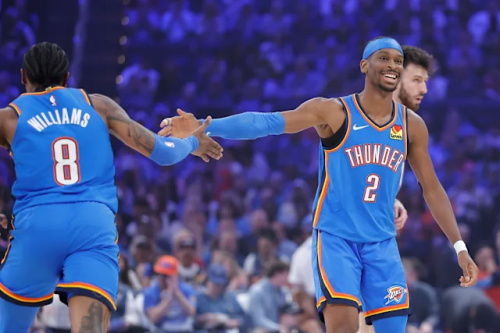
By Liam Callahan | Updated on April 8, 2026 | 🕓 18 minutes
Key Highlights
- What is a two‑way wing, and why are they so critical in modern NBA team construction?
- How does spacing and defensive switchability elevate the value of versatile wings?
- Which players are currently the top two‑way wings in the 2025–26 NBA season?
- How can teams identify emerging talent to build playoff‑ready wing rotations?
- What are the economic and strategic reasons every contender hunts for two‑way wings?
For decades, the NBA’s strategic blueprint tilted toward usage‑heavy superstars and traditional big men who dominated the paint or shot creation. Ball control and interior spacing once defined roster construction. In the modern game, however, a new archetype has emerged as both a foundation piece and a competitive differentiator: the two‑way wing. As spacing, pace, analytics, and switching defenses have matured, players capable of meaningful impact on both ends of the floor have reshaped what it means to contend for championships.
At their core, two‑way wings are perimeter players—often 6′6″ to 6′9″ (1.98–2.06 m)—who resist traditional role pigeonholing. They combine athleticism, defensive versatility, and efficient scoring without needing to dominate usage or possessions. Their scarcity and systemic value make them among the league’s most coveted roster assets.
I. Tactical Evolution: Spacing, Switching, and the Structural Shift
The rise of two‑way wings isn’t happenstance—it’s a direct consequence of how basketball is played today.
On offense, effective spacing is fundamental. With three‑point gravity governing movement and shot selection, teams that fail to create clear floor space clog their own flow. A wing who can reliably threaten from outside or cut effectively forces defensive attention, creating room for elite creators and roll actions.
Defensively, “switchability”—the ability to hedge or switch across multiple screens and positions—is paramount. As defenses increasingly employ switch‑heavy schemes to counter spread offenses, players who can defend point guards through power forwards without creating mismatches are invaluable. Teams without this flexibility succumb to isolation exploitation in late possessions or playoffs.
These combined trends have transformed today’s wing roles from simple specialists to versatile connectors of offensive and defensive syntax.
II. Offensive Impact: Space Creation, Movement, and Efficiency
Quantifying a two‑way wing’s offensive value is complex—many of their contributions don’t show up as raw counting stats, yet they are visible in spacing and possession leverage.
Spacing Gravity and Weak‑Side Actions
A perimeter player hitting 36 percent or better from three forces defenses to respect them. Even when stationed in a weak‑side corner, this player dictates rotations and prevents easy help defense into the paint. This spacing is particularly critical for stars who create—like dominant scorers and ball handlers.
Shai Gilgeous‑Alexander is a modern embodiment of this phenomenon. A combo guard with exceptional scoring and floor spacing properties, he blends shooting, slashing, and decision‑making. His 2025–26 season features historic scoring efficiency—reports note one of the highest true shooting percentages for a 30 + PPG scorer in league history—underscoring his two‑way influence: he scores efficiently while still facilitating offensive structure around him.
Off‑Ball Movement and Secondary Playmaking
True two‑way wings excel off the ball. They sprint off pin‑downs, cut behind defensive looks, and exploit closeouts. Their movement destabilizes help schemes and creates secondary assists, driving lanes, or corner shooting opportunities without possessing the ball for extended stretches.
In contemporary systems, such players are offensive equalizers—they create leverage not by volume scoring, but by consistently forcing defensive responses, which in turn frees star creators to operate with fewer congestions.
Transition and Decision‑Making
Two‑way wings often serve as flexible transition outlets—capable of finishing in the open court, initiating breaks, or quickly reading rotations for extra passes. This secondary level of playmaking enhances offensive flow and preserves tempo, a key determinant in fast‑paced modern systems.
III. Defensive Value: Switchability and Matchup Flexibility
Where the wing’s offensive contributions are sometimes subtle, their defensive utility is both immediate and systemic.
Positional Versatility
A competent two‑way wing defends guards, wings, and small bigs without glaring mismatch liabilities. This allows defensive schemes to switch pick‑and‑roll actions aggressively, reducing the need for complex hedges or recovery rotations that slow down help.
Teams with interchangeable defenders gain a strategic edge because they can neutralize isolations and minimize opponent advantages on switches.
Rim Support and Weak‑Side Defense
With the increasing prevalence of stretch bigs and drive‑oriented offenses, adjacent rim defense becomes crucial. Modern two‑way wings like Scottie Barnes and similar versatile defenders rotate effectively, contest shots, and secure floor spacing rebounding, helping to plug interior gaps while still defending perimeter threats.
Matchup Assignments Against Stars
The elite two‑way wing can be tasked with guarding the opponent’s best perimeter threat—whether a scoring guard or physical forward. These assignments often decide playoff rotations and late‑game matchups. Herb Jones of the Pelicans, for example, regularly defends top stars across multiple positions, illustrating real‑world application of versatile defense under pressure.
2025‑26 Top Two‑Way Wings: Data Table
Combining 3‑point shooting excellence, individual defensive impact, and team Net Rating influence.
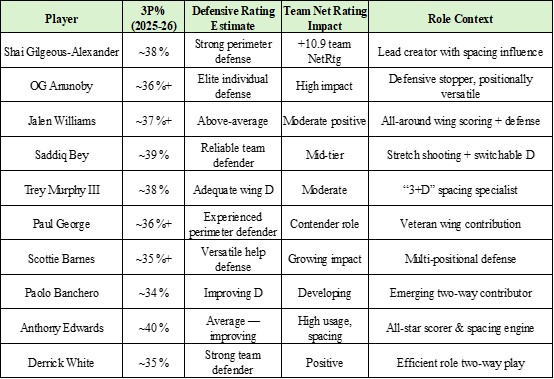
Notes on data: 3P% and role insights combine publicly available stat trends; Thunder’s leading Net Rating (+10.9) indicates a system where two‑way spacing and defensive execution correlate with winning performance.
Visualizing Spacing Impact
Player Heatmaps — Spacing Influence in 2025‑26
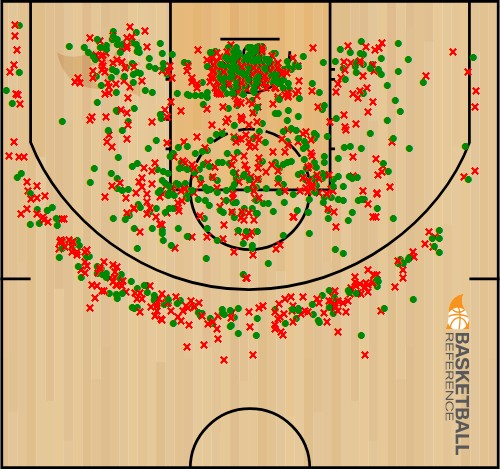
Shai Gilgeous-Alexander 2025-26 Shooting (Source: Basketball‑Reference)
Shai Gilgeous‑Alexander | Heat concentration around perimeter spacing corridors
Saddiq Bey | Corner spot‑up gravity signaling defensive attention
OG Anunoby | Rotational spacing pressure with weak‑side rotations
Trey Murphy III | Gravity in catch‑and‑shoot zones increasing driving lanes
Jalen Williams | Movement‑based spacing, off‑ball cut lanes
Heat maps illustrate how two‑way wings shape spacing by forcing defenders to respect perimeter gravity, thereby opening driving lanes and reducing congestion for primary creators and roll actions.
IV. Finals and Title Runs: Structural Proof Points
Examining recent championship runs reveals how teams that optimize two‑way wing value often outperform less versatile opponents.
The 2025 NBA Finals spotlighted a young, switch‑ready contender built around athletic versatility, perimeter spacing, and multi‑positional defense. Oklahoma City’s balance of elite creation (led by Gilgeous‑Alexander and rising stars like Jalen Williams) and versatile supporting pieces helped them contend effectively. Many bench rotation players contributed as capable defenders and multi‑faceted roles, illustrating just how tightly structural two‑way roles mesh with title expectations.
In contrast, contenders lacking this type of wing depth often struggle to contain holistic offensive attacks or sustain tempo across playoff adjustments.
V. Predicting the Next Generation (2026‑28 Outlook)
Future Two‑Way Combos to Watch
These combinations feature players whose trajectory suggests they may become dominant two‑way wings or highly attractive trade/free agent targets:
Cooper Flagg + Jalen Williams: Flagg’s defensive instincts and Williams’ spacing could form a cornerstone two‑way duo for a contending backcourt/wing future.
Nae’Qwan Tomlin + Saddiq Bey: Floor spacing meets steady defense — valuable on contending bench units.
Emerging perimeter defenders (Norman Powell, Derrick White) + shooting wings: A craft pairing maximizing spacing, perimeter D, and playoff rotation value.
High‑Upside, Under‑Paid Candidates
Several mid‑tier players might break out as impactful two‑way wings:
✔ NaQwan Tomlin (CLE): Efficient 3P shooting + improving defensive versatility.
✔ Donte DiVincenzo (MIN/other): Proven shot creation, capable defensive rotations.
✔ Emerging rookies (Cooper Flagg, others): If their defensive instincts translate, they could become foundational wings at starter salaries.
These players offer cost‑effective two‑way value that contenders will covet amid cap constraints.
VI. Scarcity and Market Economics: Why Every Contender Is Chasing Them
Two‑way wings are not just tactically useful—they are economically efficient. With tight salary caps and punitive luxury tax structures under current NBA collective bargaining rules, teams are disincentivized from carrying too many high‑usage specialists. In this environment, a well‑paid two‑way wing can replace multiple single‑skill specialists, providing value across rotations without consuming disproportionate cap space.
This economic reality explains why players like Herb Jones or Trey Murphy III are treated as near‑untouchable assets and why perennial contenders consistently seek wing upgrades through trades or free agency.
A $20 million‑a‑year two‑way wing producing spacing, defensive flexibility, and secondary creation often yields more aggregate team value than a $40 million scorer who offers little defensive impact.
Conclusion: The Competitive Edge in an Era Defined by Margins
The strategic value of two‑way wings lies not in headline domination, but in systemic stability and roster leverage. These players raise a team’s defensive floor, streamline offensive execution, and maintain lineup flexibility worthy of repeat contention.
In the 2025–26 NBA landscape, the quantity and quality of two‑way wings on a roster are among the strongest indicators of a team’s championship legitimacy. Organizations that understand this continue to chase these versatile connectors, while teams that underinvest in true two‑way wings often find their ceiling limited.
In a league defined by ever‑narrowing margins, two‑way wings are no longer supplementary pieces—they are core determinants of participation and success in the championship conversation.
References
1. Bontemps, Tim. “How the NBA’s New Collective Bargaining Agreement Will Change Team Building.” ESPN
2. Hollinger, John. “Why Two‑Way Wings Are the NBA’s Most Valuable Asset.” The Athletic
3. Mahoney, Rob. “The NBA’s Obsession with Switchability.” The Ringer
4. Pelton, Kevin. “Why Elite Role Players Are Becoming the Hardest to Find.” ESPN+
5. Basketball-Reference. (n.d.). Player shot charts. [https://www.basketball-reference.com/players/]
About the Author
Liam Callahan is a sports analytics journalist and former basketball performance analyst. He has contributed research to NBA team scouting reports and authored articles on roster construction, advanced metrics, and player development for international sports media. His professional experience includes collaboration with teams in North America and Europe to apply analytics to player evaluation and strategic decision-making.
Editorial Transparency Statement
This article is based on publicly available data from NBA statistics, verified sports journalism sources, and historical performance records. All interpretations, projections, and analysis are the author’s independent assessments. Data visualizations, tables, and player references are intended for informative purposes and to provide decision-making insights relevant to basketball team management and analysis.
Disclaimer
The content in this article is for informational and educational purposes only. It does not constitute professional advice, financial recommendation, or direct team guidance. The author and publisher are not responsible for decisions made based on the material herein. Player evaluations and projections are subject to change based on performance, injuries, trades, or other factors.
=======

By Liam Callahan | Updated on April 8, 2026 | 🕓 18 minutes
Key Highlights
- What is a two‑way wing, and why are they so critical in modern NBA team construction?
- How does spacing and defensive switchability elevate the value of versatile wings?
- Which players are currently the top two‑way wings in the 20256 NBA season?
- How can teams identify emerging talent to build playoff‑ready wing rotations?
- What are the economic and strategic reasons every contender hunts for two‑way wings?
For decades, the NBA's strategic blueprint tilted toward usage‑heavy superstars and traditional big men who dominated the paint or shot creation. Ball control and interior spacing once defined roster construction. In the modern game, however, a new archetype has emerged as both a foundation piece and a competitive differentiator: the two‑way wing. As spacing, pace, analytics, and switching defenses have matured, players capable of meaningful impact on both ends of the floor have reshaped what it means to contend for championships.
At their core, two‑way wings are perimeter players-often 6to 6(1.98.06 m)-who resist traditional role pigeonholing. They combine athleticism, defensive versatility, and efficient scoring without needing to dominate usage or possessions. Their scarcity and systemic value make them among the league's most coveted roster assets.
I. Tactical Evolution: Spacing, Switching, and the Structural Shift
The rise of two‑way wings isn't happenstance-it's a direct consequence of how basketball is played today.
On offense, effective spacing is fundamental. With three‑point gravity governing movement and shot selection, teams that fail to create clear floor space clog their own flow. A wing who can reliably threaten from outside or cut effectively forces defensive attention, creating room for elite creators and roll actions.
Defensively, "switchability"-the ability to hedge or switch across multiple screens and positions-is paramount. As defenses increasingly employ switch‑heavy schemes to counter spread offenses, players who can defend point guards through power forwards without creating mismatches are invaluable. Teams without this flexibility succumb to isolation exploitation in late possessions or playoffs.
These combined trends have transformed today's wing roles from simple specialists to versatile connectors of offensive and defensive syntax.
II. Offensive Impact: Space Creation, Movement, and Efficiency
Quantifying a two‑way wing's offensive value is complex-many of their contributions don't show up as raw counting stats, yet they are visible in spacing and possession leverage.
Spacing Gravity and Weak‑Side Actions
A perimeter player hitting 36 percent or better from three forces defenses to respect them. Even when stationed in a weak‑side corner, this player dictates rotations and prevents easy help defense into the paint. This spacing is particularly critical for stars who create-like dominant scorers and ball handlers.
Shai Gilgeous‑Alexander is a modern embodiment of this phenomenon. A combo guard with exceptional scoring and floor spacing properties, he blends shooting, slashing, and decision‑making. His 20256 season features historic scoring efficiency-reports note one of the highest true shooting percentages for a 30 + PPG scorer in league history-underscoring his two‑way influence: he scores efficiently while still facilitating offensive structure around him.
Off‑Ball Movement and Secondary Playmaking
True two‑way wings excel off the ball. They sprint off pin‑downs, cut behind defensive looks, and exploit closeouts. Their movement destabilizes help schemes and creates secondary assists, driving lanes, or corner shooting opportunities without possessing the ball for extended stretches.
In contemporary systems, such players are offensive equalizers-they create leverage not by volume scoring, but by consistently forcing defensive responses, which in turn frees star creators to operate with fewer congestions.
Transition and Decision‑Making
Two‑way wings often serve as flexible transition outlets-capable of finishing in the open court, initiating breaks, or quickly reading rotations for extra passes. This secondary level of playmaking enhances offensive flow and preserves tempo, a key determinant in fast‑paced modern systems.
III. Defensive Value: Switchability and Matchup Flexibility
Where the wing's offensive contributions are sometimes subtle, their defensive utility is both immediate and systemic.
Positional Versatility
A competent two‑way wing defends guards, wings, and small bigs without glaring mismatch liabilities. This allows defensive schemes to switch pick‑and‑roll actions aggressively, reducing the need for complex hedges or recovery rotations that slow down help.
Teams with interchangeable defenders gain a strategic edge because they can neutralize isolations and minimize opponent advantages on switches.
Rim Support and Weak‑Side Defense
With the increasing prevalence of stretch bigs and drive‑oriented offenses, adjacent rim defense becomes crucial. Modern two‑way wings like Scottie Barnes and similar versatile defenders rotate effectively, contest shots, and secure floor spacing rebounding, helping to plug interior gaps while still defending perimeter threats.
Matchup Assignments Against Stars
The elite two‑way wing can be tasked with guarding the opponent's best perimeter threat-whether a scoring guard or physical forward. These assignments often decide playoff rotations and late‑game matchups. Herb Jones of the Pelicans, for example, regularly defends top stars across multiple positions, illustrating real‑world application of versatile defense under pressure.
20256 Top Two‑Way Wings: Data Table
Combining 3‑point shooting excellence, individual defensive impact, and team Net Rating influence.

Notes on data: 3P% and role insights combine publicly available stat trends; Thunder's leading Net Rating (+10.9) indicates a system where two‑way spacing and defensive execution correlate with winning performance.
Visualizing Spacing Impact
Player Heatmaps Spacing Influence in 20256

Shai Gilgeous-Alexander 2025-26 Shooting (Source: Basketball‑Reference)
Shai Gilgeous‑Alexander | Heat concentration around perimeter spacing corridors
Saddiq Bey | Corner spot‑up gravity signaling defensive attention
OG Anunoby | Rotational spacing pressure with weak‑side rotations
Trey Murphy III | Gravity in catch‑and‑shoot zones increasing driving lanes
Jalen Williams | Movement‑based spacing, off‑ball cut lanes
Heat maps illustrate how two‑way wings shape spacing by forcing defenders to respect perimeter gravity, thereby opening driving lanes and reducing congestion for primary creators and roll actions.
IV. Finals and Title Runs: Structural Proof Points
Examining recent championship runs reveals how teams that optimize two‑way wing value often outperform less versatile opponents.
The 2025 NBA Finals spotlighted a young, switch‑ready contender built around athletic versatility, perimeter spacing, and multi‑positional defense. Oklahoma City's balance of elite creation (led by Gilgeous‑Alexander and rising stars like Jalen Williams) and versatile supporting pieces helped them contend effectively. Many bench rotation players contributed as capable defenders and multi‑faceted roles, illustrating just how tightly structural two‑way roles mesh with title expectations.
In contrast, contenders lacking this type of wing depth often struggle to contain holistic offensive attacks or sustain tempo across playoff adjustments.
V. Predicting the Next Generation (20268 Outlook)
Future Two‑Way Combos to Watch
These combinations feature players whose trajectory suggests they may become dominant two‑way wings or highly attractive trade/free agent targets:
Cooper Flagg + Jalen Williams: Flagg's defensive instincts and Williamsspacing could form a cornerstone two‑way duo for a contending backcourt/wing future.
Nae'Qwan Tomlin + Saddiq Bey: Floor spacing meets steady defense valuable on contending bench units.
Emerging perimeter defenders (Norman Powell, Derrick White) + shooting wings: A craft pairing maximizing spacing, perimeter D, and playoff rotation value.
High‑Upside, Under‑Paid Candidates
Several mid‑tier players might break out as impactful two‑way wings:
strong> NaQwan Tomlin (CLE): Efficient 3P shooting + improving defensive versatility.
Donte DiVincenzo (MIN/other): Proven shot creation, capable defensive rotations.
Emerging rookies (Cooper Flagg, others): If their defensive instincts translate, they could become foundational wings at starter salaries.
These players offer cost‑effective two‑way value that contenders will covet amid cap constraints.
VI. Scarcity and Market Economics: Why Every Contender Is Chasing Them
Two‑way wings are not just tactically useful-they are economically efficient. With tight salary caps and punitive luxury tax structures under current NBA collective bargaining rules, teams are disincentivized from carrying too many high‑usage specialists. In this environment, a well‑paid two‑way wing can replace multiple single‑skill specialists, providing value across rotations without consuming disproportionate cap space.
This economic reality explains why players like Herb Jones or Trey Murphy III are treated as near‑untouchable assets and why perennial contenders consistently seek wing upgrades through trades or free agency.
A $20 million‑a‑year two‑way wing producing spacing, defensive flexibility, and secondary creation often yields more aggregate team value than a $40 million scorer who offers little defensive impact.
Conclusion: The Competitive Edge in an Era Defined by Margins
The strategic value of two‑way wings lies not in headline domination, but in systemic stability and roster leverage. These players raise a team's defensive floor, streamline offensive execution, and maintain lineup flexibility worthy of repeat contention.
In the 20256 NBA landscape, the quantity and quality of two‑way wings on a roster are among the strongest indicators of a team's championship legitimacy. Organizations that understand this continue to chase these versatile connectors, while teams that underinvest in true two‑way wings often find their ceiling limited.
In a league defined by ever‑narrowing margins, two‑way wings are no longer supplementary pieces-they are core determinants of participation and success in the championship conversation.
References
1. Bontemps, Tim. "How the NBA's New Collective Bargaining Agreement Will Change Team Building.ESPN
2. Hollinger, John. "Why Two‑Way Wings Are the NBA's Most Valuable Asset.The Athletic
3. Mahoney, Rob. "The NBA's Obsession with Switchability.The Ringer
4. Pelton, Kevin. "Why Elite Role Players Are Becoming the Hardest to Find.ESPN+
5. Basketball-Reference. (n.d.). Player shot charts. [https://www.basketball-reference.com/players/]
About the Author
Liam Callahan is a sports analytics journalist and former basketball performance analyst. He has contributed research to NBA team scouting reports and authored articles on roster construction, advanced metrics, and player development for international sports media. His professional experience includes collaboration with teams in North America and Europe to apply analytics to player evaluation and strategic decision-making.
Editorial Transparency Statement
This article is based on publicly available data from NBA statistics, verified sports journalism sources, and historical performance records. All interpretations, projections, and analysis are the author's independent assessments. Data visualizations, tables, and player references are intended for informative purposes and to provide decision-making insights relevant to basketball team management and analysis.
Disclaimer
The content in this article is for informational and educational purposes only. It does not constitute professional advice, financial recommendation, or direct team guidance. The author and publisher are not responsible for decisions made based on the material herein. Player evaluations and projections are subject to change based on performance, injuries, trades, or other factors.
>>>>>>> 63583bcf2d1c48866d6cb09279ca425cc19a4907 =======
 >>>>>>> 63583bcf2d1c48866d6cb09279ca425cc19a4907
The Rise of Pickleball and Small-Court Sports: Why Racquet Games Are Becoming Faster, Smaller, and More Social
=======
>>>>>>> 63583bcf2d1c48866d6cb09279ca425cc19a4907
LA28 Olympics: Why Squash, Flag Football, and Cricket Are Shaping the Future of the Games
=======
>>>>>>> 63583bcf2d1c48866d6cb09279ca425cc19a4907
From Niche to Mainstream: The Explosive Growth of Competitive Climbing and Sport Climbing
=======
>>>>>>> 63583bcf2d1c48866d6cb09279ca425cc19a4907
Is Adventure Racing the Next Big Outdoor Trend in Asia?